
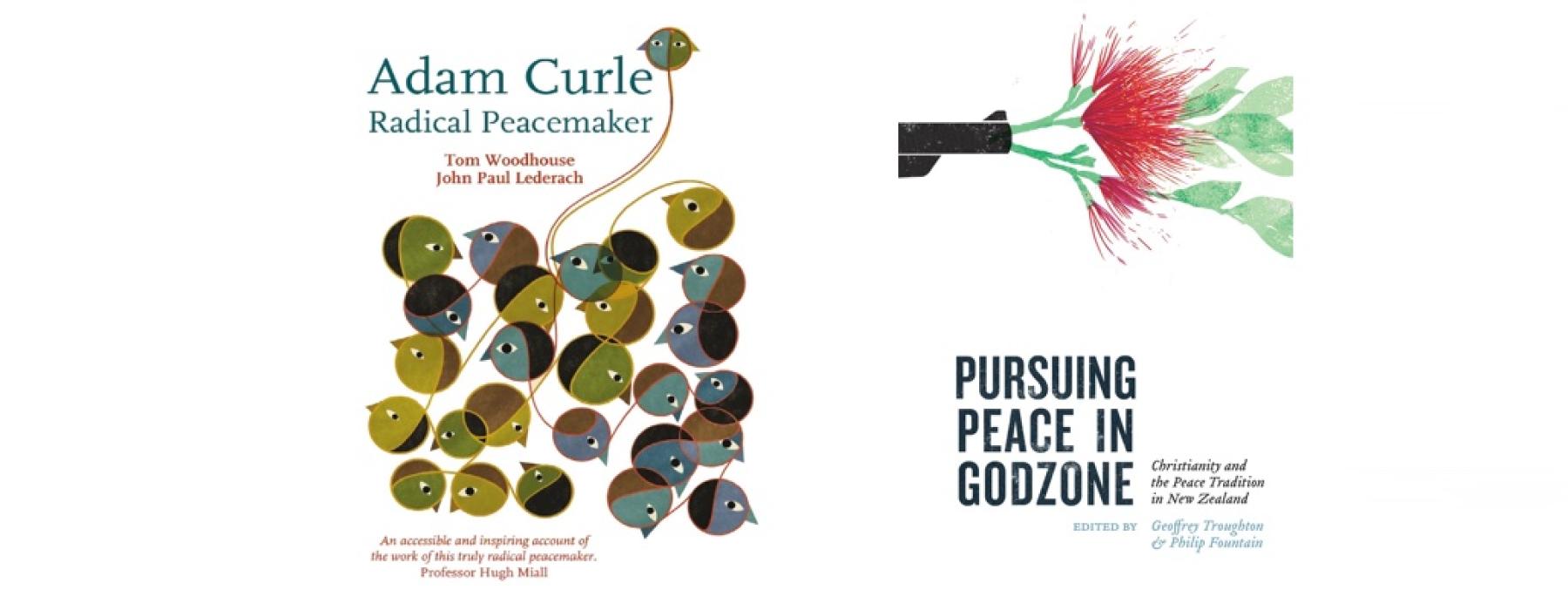
Two Books About Peacemaking
Reviewed by Jan Marsh
Adam Curle, radical peace-maker, by Tom Woodhouse and John Paul Lederach,
Hawthorne Press 2016
Pursuing peace in Godzone, edited by Geoffrey Troughton and Philip Fountain,
Victoria University Press 2018
Adam Curle, known for his extensive writing and study of peace-making and his courageous mediation work in war zones around the world, was born near Paris in 1916. His mother had moved there from England in order to show solidarity with the French during WWI and to be near her brothers who were in the trenches and in the Navy. Perhaps he was destined from birth for a lifetime opposing war.
He was also part of a large family with strong roots in the English traditons of scholarship and the arts. His mother's sister married Ralph Vaughan Williams, the composer, and there were also strong connections with the Bloomsbury Group which included Virginia Woolf and Vanessa Bell. His mother, having lost three of her brothers in the war, was a pacificist and influenced Adam's politics to the extent that he became a Quaker in 1959.
This book provides a short biography of Adam Curle and also gives selections of his writings on peace-making and mediation, particularly during his time as Professor of the Bradford School of Peace Studies and at Harvard.
His work on the ground in Nigeria, South Africa and other conflict zones convinced him that mediation was not possible between hostile and unequal participants and that the first steps needed to build, maintain and enhance the channels of communication. He developed an explicit and well thought out process for mediators and peace-makers which is fully explored in the book.
Curle's four-step process is: Research (understanding the background to the conflict and the
positions of the parties),
Conciliation (trust-building and equalising imbalances),
Bargaining to get the needs of all parties met, and
Development (ongoing well-being and positive growth).
He points out that many approaches to conflict resolution focus only on bargaining and often regard success as what he calls negative peace i.e. the absence of war. Even without war, 'unpeace' can exist in states of deprivation and suppression where development is held back. For Curle, the goal goes beyond the end of war to establishing justice and development.
In places his writings jar a little, with an air of patronage which is of course 'of his time' given that he was born into Edwardian England at the height of its colonial mission. However, the humanity and thoroughness of his approach and his poetry which is included to illustrate certain points, make it easy to forgive those flaws and look instead to the legacy of his experience and work.
Pursuing Peace in Godzone looks at the role of Christianity in peace and war in New Zealand. Despite obvious Biblical injunctions such as 'Thou shalt not kill' and 'Blessed are the peace-makers', Christianity has not been whole-hearted in pursuing peace. Protestors and peace-makers within certain congregations have been criticised and even ex-communicated. However, many prominent and courageous activists have drawn on their Christian beliefs and persisted in spite of opposition from their faith communities who they might reasonably have expected to support them.
The book begins with an analysis by the two editors of Anzac Day and the way in which it has developed myth and meaning while also creating ambiguity and controversy. Does Anzac Day glorify war? Or does it mourn the loss, courage and sacrifice? Is it permissable to witness for peace on that day?
There are articles about a wide variety of movements, from the conscientious objectors of both world wars, the nuclear free movement and the flotillas which opposed US warships entering NZ harbours and nuclear tests in the Pacific, and the movement against Apartheid in South Africa which saw three committed New Zealanders become deeply involved.
The book also examines the 'just war' theory and asks where Jesus would stand on Anzac Day.
Elizabeth Duke has contributed a chapter on the role of Quakers as a 'peace church' and also makes reference to Adam Curle. A final chapter by the editors puts all of this into context and perspective and brings us back to reflecting on the story and teachings of Jesus.
This is a very worthwhile book to read from cover to cover or to dip into the chapters which hold special interest. As an examination of an idea in the light of history, it has a lot to contribute to our present troubled times.