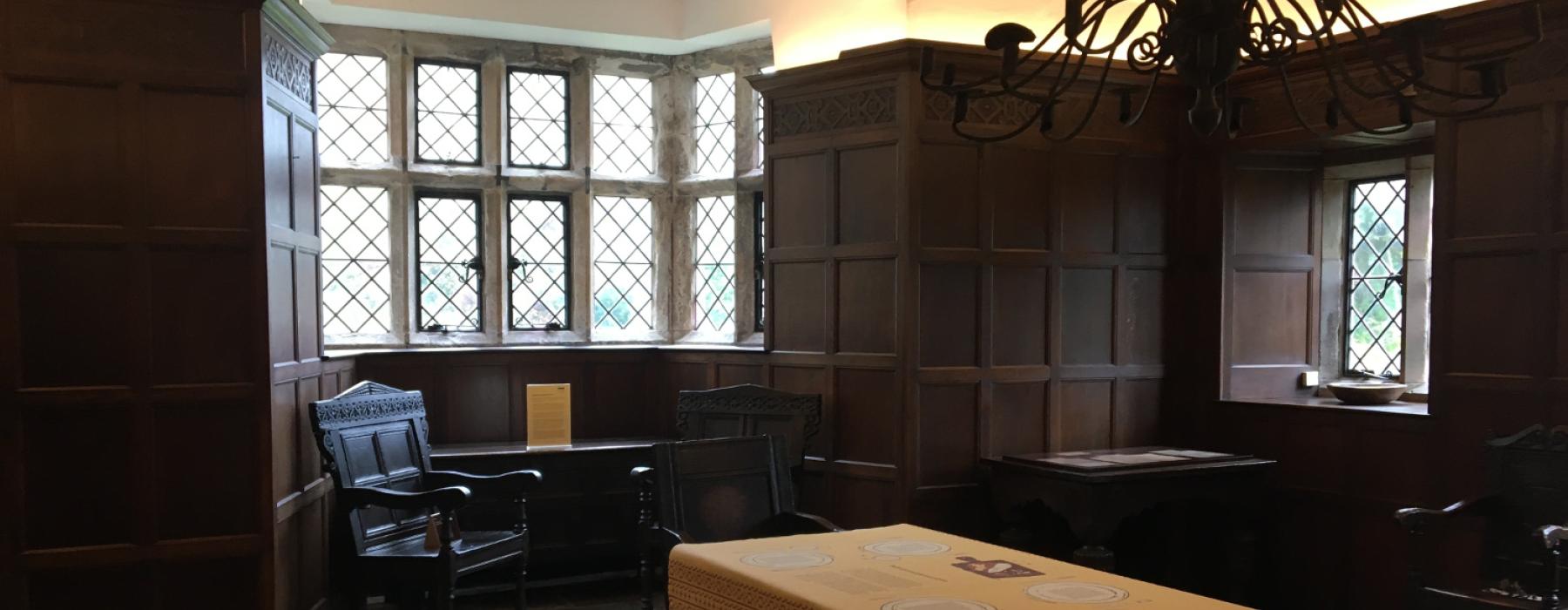
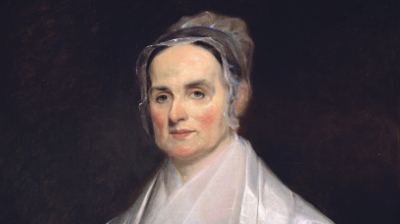
Swarthmoor Hall was home to Thomas and Margaret Fell. Margaret played an important part in the founding of the Quaker movement in the 17th century. Some years after Thomas Fell died, George Fox and Margaret Fell got married, and George Fox returned to the Hall intermittently during his lifetime, writing his famous journal here in 1675. It remains in use today as a Quaker retreat house.
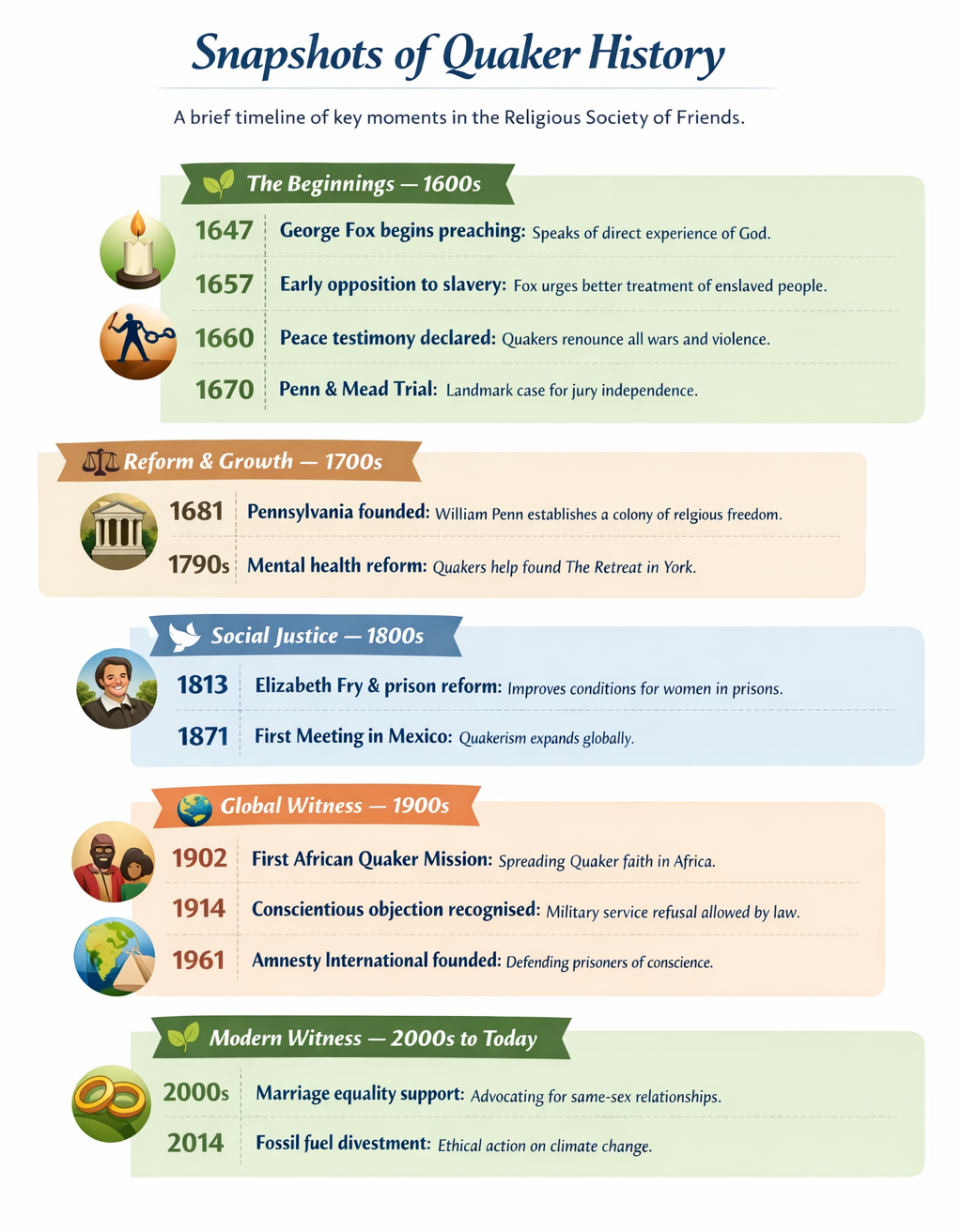
Welcome to a brief history — snapshots of Quaker activity since 1647:
This timeline shares a few key moments from Quaker history.
It shows how Friends, from the 1600s to today, have tried to live their faith — working for peace, fairness, and care for people and the Planet. These snapshots give a sense of how Quaker beliefs have been put into practice over time.
Explore these moments in more detail:
The Beginnings — 1600s
1647 — George Fox begins preaching
George Fox began travelling around England, speaking about a direct and personal experience of God. He taught that everyone could listen inwardly for truth, without needing priests, churches, or set rituals. These ideas challenged the religious authorities of the time and laid the foundations for the Quaker movement.
This video tells the story of two founders of Quakerism, George Fox and Margaret Fell, and the earliest centre of Quakerism at Swarthmoor Hall:
1657 — Early opposition to slavery
George Fox and other early Friends spoke out against the harsh treatment of enslaved people. While views developed over time, these early concerns planted the seeds for later, stronger Quaker opposition to slavery and involvement in abolition movements.
Important Early Quaker Publication: Robert Barclay: Apology for the True Christian Divinity. Barclay argued that personal experience of God is more meaningful than scripture.
1660 — Peace testimony declared
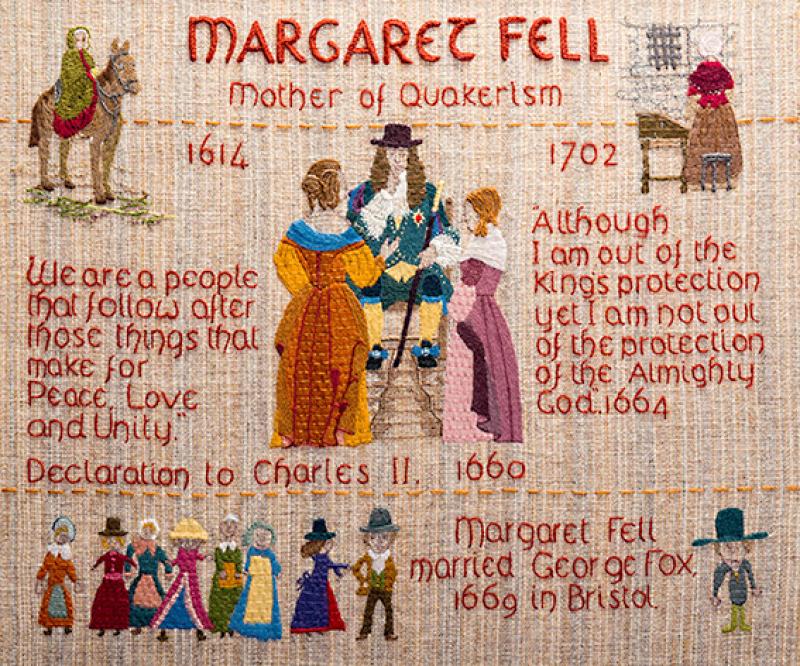
In a statement to the King of England, Quakers declared that they refused all outward wars and violence. This became known as the Peace Testimony. From this point on, Friends have sought to live without violence and to work for peaceful ways of resolving conflict.
Read more about Margaret Fell, "the mother of Quakerism" here
1670 — The Penn and Mead Trial
Quakers William Penn and William Mead were arrested for preaching in public. When the jury refused to convict them, despite pressure from the judge, the case helped establish the principle that juries should not be punished for their decisions. This trial became an important moment in the history of civil liberties.
1698 - Persecution continues
The first Quaker elected to the British Parliament is not allowed to take his seat after refusing to take the oath of Allegiance to the Crown.
Reform & Growth — 1700s
1681 — Pennsylvania founded
William Penn founded the colony of Pennsylvania as a place of religious freedom and fair treatment. It welcomed people of different faiths and backgrounds and aimed to govern through justice rather than force. These ideas were unusual at the time and influenced later democratic thinking.
1790s — Mental health reform
Quakers were involved in founding The Retreat in York, England. This was a new kind of place for people with mental illness, focusing on kindness, dignity, and care rather than punishment. It helped change attitudes toward mental health treatment more widely.
Social Justice — 1800s
1813 — Elizabeth Fry and prison reform
Elizabeth Fry began visiting women in Newgate Prison in London. She worked to improve living conditions, education, and treatment for prisoners, especially women and children. Her work influenced prison reform in Britain and beyond. Quaker involvement with prison reform and prisoner aid continues today.
1871 — First Quaker Meeting in Mexico
The establishment of a Quaker Meeting in Mexico marked further growth of the Religious Society of Friends beyond Europe and North America. It reflected the spread of Quaker faith into new cultural and social contexts. Today, 17% of the world’s Quakers are in Central and South America.
Global Witness — 1900s
1902 — First African Quaker Mission
Quakers began organised work in parts of Africa, combining faith, education, and community support. African Quaker communities grew and developed their own strong traditions, many of which continue today. 45% of the world's Quakers are in Africa.
1914 — Conscientious objection recognised
During the First World War, the right to refuse military service on moral or religious grounds was recognised in British law thanks to the work of three Quaker MPs, and later formed part of the Universal Declaration on Human Rights. Many Quakers registered as conscientious objectors, staying true to their peace testimony despite public pressure and hardship.
1930s - 40s - Support for Refugees
Throughout the 1930s, Quakers in Germany were active in finding ways to save the lives of refugees. From 1939 they worked with English Quakers and other groups to ensure the safe passage of thousands of Jewish children and looked after them in their countries of refuge. In 1947, Quakers were awarded the Nobel Peace Prize for their work in the reconstruction of Europe after the devastation of the war.
1961 — Amnesty International founded
Peter Benenson, a British Quaker, helped found Amnesty International. The organisation works to protect prisoners of conscience and promote human rights around the world. It reflects Quaker concerns for justice, compassion, and human dignity.
1963 - "I have a Dream" March
Quaker Bayard Rustin was the primary organiser of Martin Luther King’s “I have a Dream” march in Washington.
1980s- 1990s - Working for Peace in Northern Ireland
Quakers played a prominent role in working for peace in Northern Ireland and in setting up ‘Turning the Tide’ workshops for non-violent resolution of differences which are now held worldwide. Quakers also played an active role in the successful movement to ban the deployment of land mines (1997).
Modern Witness — 2000s to Today
2000s — Support for marriage equality
Many Quaker meetings publicly supported the recognition of same-sex relationships and marriage equality. This grew from the Quaker belief in equality and the importance of loving, committed relationships.
2014 — Fossil fuel divestment
Quakers committed to removing fossil fuel investments from their funds. This action reflected concern for the Earth, future generations, and the impact of climate change on vulnerable communities.
Together, these moments show how Quakers have tried, imperfectly but persistently, to live out their faith through action as well as belief.
Quakers Active in Underground Railroad and Slavery Abolition
1758
Quakers in Pennsylvania worked towards the abolition of the slave trade.
1763
American Quaker John Woolman urged Quakers to “live answerable to the design of our creation”, calling them to live a simple life with careful use of the earth’s resources. Woolman was also one of the most outspoken opponents of slave ownership among Quakers.
1783
British Quakers established theAnti-Slavery Committee which was instrumental in driving the movement throughout the next 50 years. The slave trade was abolished in 1807 and ultimately slavery was forbidden throughout the British Empire in 1833.
Image
Quaker Women in 19th Century America
Quaker women were very active in 19th Century America, supporting the anti-slavery movement, and arguing for equality with men within Quaker communities.
This talk by Nelson Friend Phillida Bunkle outlines these two aspects of their work, telling their stories, the difficulties they faced, the sacrifices they made, and the successes they had.