
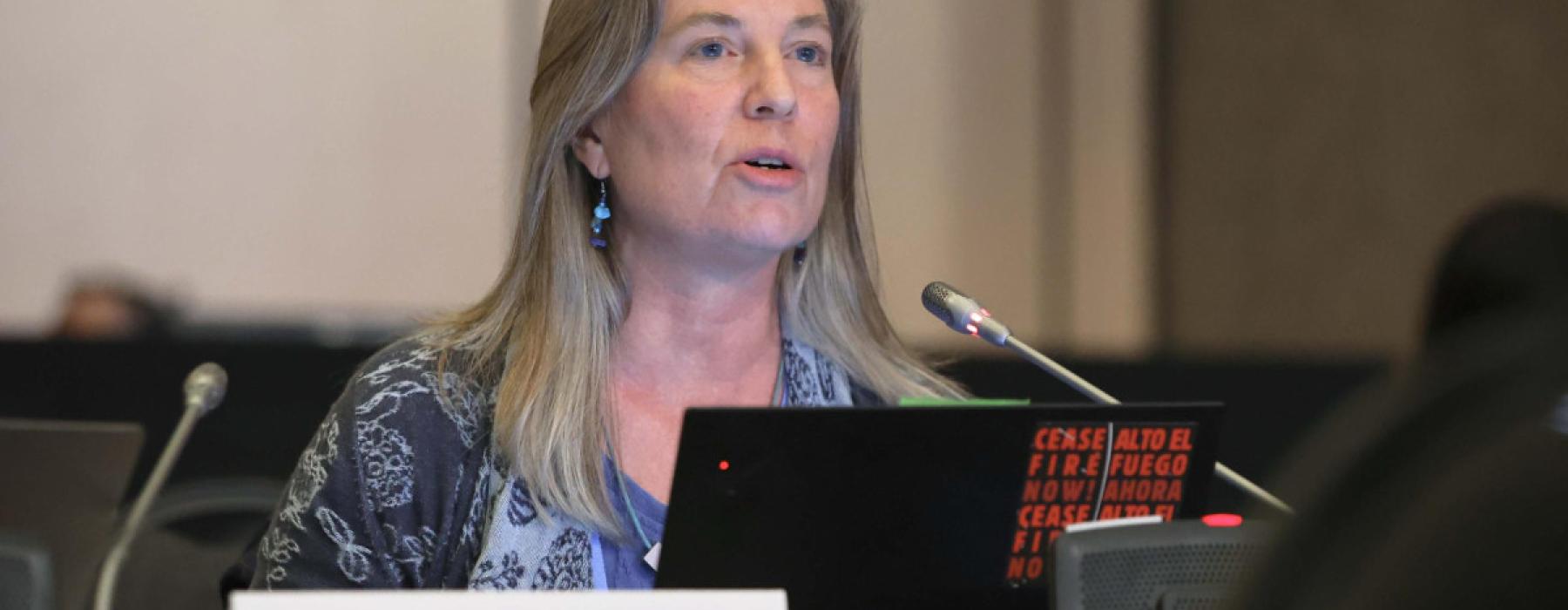
Presentation from Lindsey Fielder Cook to Summer Gathering 2 January 2026.
Notes by Phillipa Fletcher, Climate Emergency Correspondent. Lindsey has checked the notes. Any mistakes or misrepresentations are Phillipa's responsibility and should not be attributed to Lindsey or other Friends.
Presentation from Lindsey Fielder Cook, Quaker United Nations Office
Summer Gathering 2 January 2026
One day before the US attacked Venezuela, Lindsey, Quaker United Nations Office (QUNO) Representative for the Human Impacts of Climate Change, Geneva, addressed our Summer Gathering.
The following are my notes from Lindsey’s presentation as checked out with her. Any mistakes or misrepresentations are my responsibility and should not be attributed to Lindsey or other Friends.
Friends’ Spiritual Contribution
We are in a period of rebirth. It is painful but it can bring about something beautiful. Friends have a role in healing; a way of upholding pain with love, which can be helpful in this time of planetary crisis.[1]
Quakers come with a sense that we do not have the one answer, but that a way forward becomes clearer in unity. This is reflected in our history without a creed – we are open to learning with others, and this approach is often helpful in bringing people together to face planetary crises.
We also come with a sense of personal role and responsibility, just as we have no priests. But we all have responsibility for the spiritual well-being of a Meeting. This helps us feel comfortable in multi-faith spaces.
We embrace transformation and how we can live within transformation. Our testimonies can provide a grounding of what is needed.
Lindsey appreciates Aotearoa New Zealand Friends’ support - both intellectually and pastorally.
Multilateral environment
The international political environment is in its tensest time in many decades, and Aotearoa NZ is in a sensitive area of the world [this was the day before the US and Venezuela debacle].
Power alliances are shifting and there is a void with the USA pulling away from the rules-based international order.
The gaps mean we are in a tender place. In our work, we have seen an increase in serious ‘pushback’ (denial) from countries and industries driving unsustainable economic systems, unsustainable food systems and unsustainable energy systems. However, we are also seeing a cracking of this dominant denial, as evidenced at the Conference of the Parties (COP) 30 meeting in Brazil last November.[2] [Lindsey’s COP reflections can be found at https://quno.org/wp-content/uploads/2026/01/QUNO-Reflection-on-COP30-Brazil.pdf ].
Quakers have a special role in upholding at a time which can be very scary for others.
Lindsey described the current situation which includes increased military budgets, failures in multilateralism, reduced budgets for UN organisations, the Security Council failing to maintain peace and security, Russia and missiles in Belarus, China and military drills around Taiwan, insufficient AI regulation, and the genocide in Gaza which she referred to as an epicentre of current efforts to destroy international laws and norms.
The US is not taking part in negotiations, and there are incidents of US officials threatening diplomats with personal sanctions if they vote against US interests. These incidents were reported in the New York Times as well.
In Geneva, UN work is deeply grounded on human rights. And there are strong voices recognising that fear and greed do not offer a vision for the common good.
The Pacific
Aotearoa NZ has lost its visionary voice in the Umbrella group.[3] It had had a strong questioning voice. We do still tend to support the EU and Small Island States but are increasingly likely to support false climate policy options which do not solve the problem e.g. carbon markets.
Aotearoa NZ is now seen as a disappointment. Canada now stands up for indigenous rights more than NZ, and the UK is the only developed country capping new fossil fuel extraction licences.
Pacific Island states have an important role in speaking honestly. They are often a moral voice which is quieter but strong. They are the canary in the cave voice.
The [Vanuatu led] International Court of Justice decision [on climate change] is profoundly clear and has given real strength to people working on the issues.[4]
COP 30
Lindsey spoke of ‘honesty’ and ‘cracking’ at COP 30. In the second week, a diverse group of more than 80 developed and developing countries came together to commit to an equitable phase out of fossil fuels. They said ‘enough’ to the denial in the COPs where the mention of fossil fuels has been silenced.
Brazil itself has a powerful emerging voice and is a member of the BRICS collection of countries, but they are unique as a progressive and environmentally focused BRIC government.[5] Their Minister for the Environment promoted deep discussions on ethics, fossil fuel phase out and deforestation. Brazil did engage with the root causes of climate change, even if these affected their economy.
This was also the first COP in a democracy since 2021 and there were protests, marches, and the voices of indigenous people [including a group from Aotearoa NZ].
In contrast, Daniella Campos (programme Assistant in the Human Impacts of Climate Change program) and Lindsey had been at the International Panel on Climate Change meeting in Peru in October, where the timeline was blocked and strategies to discredit science were getting stronger.
In the second week of the COP, people and countries, both developed and underdeveloped got louder with their concerns. Countries such as Iceland were labelling climate change a security threat.
83 countries came together to call for a move away from fossil fuels (Aotearoa NZ was not one of them).[6]
Governments of Colombia and the Netherlands showed leadership by announcing they will co-host the First International Conference on the Just Transition Away from Fossil Fuels next April. https://fossilfueltreaty.org/first-international-conference.
Alaa Abd el Fattah, recently released after 12 years’ incarceration as a political prisoner describes the situation ‘There is a deadlock of imagination in the Global North, and there is a deadlock of possibility in the Global South’.[7]
Lindsey’s conclusion: There is forever work to do
Discussion
Hope
We want to keep hope around the 1.5 goal [ e.g. … COP30 showed that climate cooperation is alive and kicking, keeping humanity in the fight for a liveable planet, with a firm resolve to keep 1.5C within reach. UN Climate Change Executive
What we can do differently
We need to get better at telling the story of what climate policies could lead to more healthy, equitable and balanced societies. It is very easy and understandable to focus on doom, but this can disempower. There is much we could do.
We can ask if climate policy decisions are promoting health, or if they are avoiding root cause transformation. If the latter, why are we choosing these options?
We can ask “Where are we using our money?’
We can highlight policies which are both healthful and more equitable.
People need our hope. Our young people do not need our despair
It can be very powerful to make comparisons, for example, one trident submarine costs the same as XYZ nurses or XYZ cyclone resilient homes in the Pacific.
QUNO’s multilateral support is unique.
QUNO is seen as even handed in a place like Geneva which can be very status focused.
Given the current environment, there is more pressure on QUNO, but there are fewer resources to carry out more work.
Current challenges
The US is not upholding international law, which enables countries like Israel to also not uphold international law.
People are being silenced and people protesting are being arrested. All this is destabilising. There is personal targeted pressure on people.
Populism, as well as right wing promises which are not delivering. Both are threats to democracies.
China has a major advantage in minerals critical for renewable energy. But the renewal of the arms race means valuable minerals are being used to develop weaponry.[8]
We have to act on fossil fuel phase out – because otherwise we spend more money adapting (Sierra Leone) with increasing suffering.
Energy transformation could focus on individual and community owned renewable energy systems, which would benefit many people at a much more local level and so therefore is threatening to the current world order based on energy power bases.[9]
Every developed country apart from the UK is increasing oil and gas production.
Aotearoa NZ’s tree planting puts us in a holding pattern and does not provide a real solution. The IPCC is not allowed to be policy prescriptive, so it has to offer all options, even those high-risk non-solutions.[10] This is a real challenge when political pressures increase to silence risk language.
Taxing the main drivers of climate change, including high wealth, is still insufficient.
Governments need to have the confidence to go against those with large amounts of power.
The increase in militarism is higher than any time since the Cold War. Military emissions are not counted.
Some concluding remarks
Humanity needs to learn how to live together. This is the example Quakers can provide.
Support just and peaceful approaches to helping those currently most affected by the impacts of climate change – just transitions are important norms to establish to protect all humanity.
Take the people with you.
The key is supporting the poorest in whatever we do.
Ask – What really makes us safe?
In a later email, Lindsey wrote: A colleague recently talked of the compass and the map. The map is the science and possible policies for action. The compass is the values and ethics which guide our choices. I found that a beautiful, powerful image.
Thank you, Lindsey; we wish you peace and strength for the journey
[1] People speak of a triple planetary crisis: climate change, pollution and biodiversity loss. See https://unfccc.int/news/what-is-the-triple-planetary-crisis
[2] See Lindsey’s involvement in an interfaith forum at COP 30 at https://interfaith-climate.com/?p=6876, and QUNO’s reflection on the COP at https://mcusercontent.com/cb3624c69c4f67e7135b592e5/files/0938ff47-af19-ee14-83b9-cfb133307f4a/QUNO_Reflection_on_COP30_Brazil.pdf
[3] the founding members were Japan, the United States, Canada, Australia, Norway and New Zealand – countries that like to take a common approach to climate change
[4] See https://www.icj-cij.org/sites/default/files/case-related/187/187-20250723-sum-01-00-en.pdf From the decision: Taking into account the adverse effects of climate change on the enjoyment of human rights, the Court considers that the full enjoyment of human rights cannot be ensured without the protection of the climate system and other parts of the environment. In order to guarantee the effective enjoyment of human rights, States must take measures to protect the climate system and other parts of the environment. These measures may include, inter alia, taking mitigation and adaptation measures, with due account given to the protection of human rights, the adoption of standards and legislation, and the regulation of the activities of private actors. Under international human rights law, States are required to take necessary measures in this regard.
[5] The BRICS countries describe themselves at https://brics.br/en/about-the-brics
[6] [Cook Islands, Fiji, Kiribati, Marshall Islands, Micronesia (Federated States of), Nauru, Niue, Papua New Guinea, Palau, Solomon Islands, Samoa, Tonga, Tuvalu, Vanuatu
Antigua and Barbuda, Austria, Bahamas, Barbados, Belgium, Belize, Brazil, Bulgaria, Cabo Verde, Chile, Colombia, Comoros, Costa Rica, Croatia, Cuba, Cyprus, Czech Republic, Denmark, Dominica, Dominican Republic, Estonia, Finland, France. Georgia, Germany, Greece, Grenada, Guatemala, Guinea-Bissau, Guyana, Haiti, Honduras, Hungary, Ireland, Jamaica, Kenya. Latvia, Liechtenstein, Lithuania, Luxembourg, Maldives, Malta, Mauritius, Mexico, Monaco, Mongolia, Netherlands, Norway, Panama, Paraguay, Peru, Portugal, Republic of Korea, Romania, São Tomé and Príncipe, Sierra Leone, Slovakia, Slovenia, Spain, St. Kitts and Nevis, St. Lucia, St. Vincent and the Grenadines, Suriname, Sweden, Switzerland, Timor-Leste, Trinidad and Tobago, UK,
Countries absent from the list include: Australia, Canada, China, Egypt, Greenland, India, New Zealand, Russia, Saudi Arabia, United States, Venezuela, Yemen.]
[7] https://en.wikipedia.org/wiki/Alaa_Abd_El-Fattah
[8] See discussions about antimony from Reefton.
[9] Interested people may like https://en.wikipedia.org/wiki/The_Prize:_The_Epic_Quest_for_Oil,_Money,_and_Power