New Zealand’s “foremost classical composer”
Douglas Gordon Lilburn was the seventh and youngest child in his family. The Lilburns owned Drysdale Station, a big sheep and beef farm in the upper Turakina Valley. Douglas loved his childhood there and his later visits to the place. It lingered in his mind and influenced his music. In 1925 when he was 10 years old his parents moved to Whanganui and left his oldest brother to run the farm.
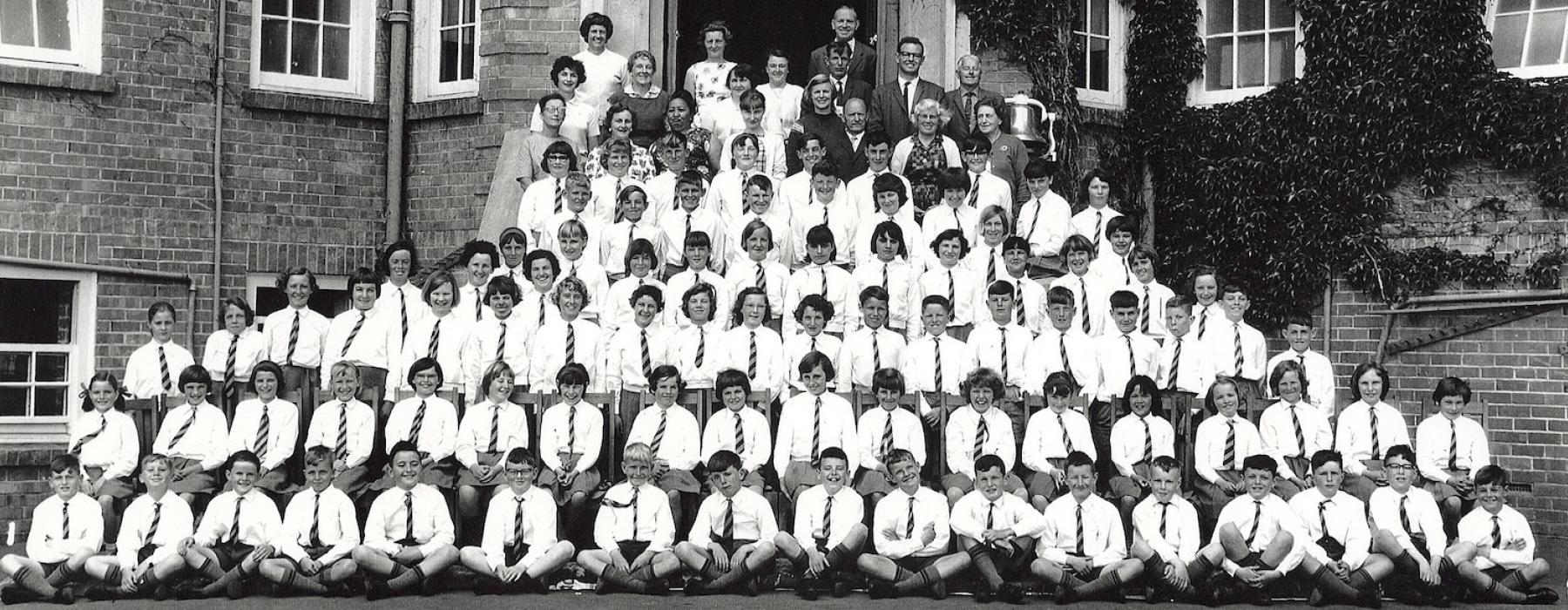
In Whanganui the family moved to a house in what’s now Great North Road, across the road from Friends School on St Johns Hill. Douglas (who was called “Gordon” at the time) was sent there as a day boy.
Looking back on his time at Friends School, he described it as his “hospice” (meaning a safe caring place), writing that it provided him with the “most enlightened and imaginative teaching that ever I had, given by an English couple, the Mortons, and their Quaker tradition. I was privileged to have this for the next three years.” The family later moved to Peakes Rd but he was able to continue at his “loved school” where he had his first piano lessons.
He remembered Friends School as being ahead of its time: “The teaching at the school was wonderfully imaginative for its time. We students worked relaxedly at our own speed to meet a quota of assignments each term. Apart from basics we were given a wide range of exploratory projects to stimulate and delight our young minds. We learnt French, say, not just from textbook grammar, but by attending a lunch at which only French might be spoken. I was entirely happy with the school, but as a day boy I was cut off from the boarders, and I made no lasting friends. Given good basic teaching I gained my Proficiency just as I turned twelve, an early age then.”
(Source: “Douglas Lilburn: Memories of Early Years and other writings” by Robert Hoskins, published by Steele Roberts, 2014).
A Poet, postman, teacher, dramatist, writer, social critic
James Keir Baxter was born in 1926. His parents were socialists and pacifists. His father Archibald is probably the most famous of New Zealand’s conscientious objectors during World War I. His book “We will not cease” was written during a two-year family sojourn in England, during which the Baxters’ two sons, Terence and James, attended a Quaker boarding school in the Cotswalds - Sibford. When Baxter family returned to New Zealand, the boys were sent as boarders to Friends School Whanganui; a homecoming of sorts as they had attended as ‘day students’ for a year prior to their travels. However, a homecoming that also was awkward as Baxter recalled feeling ‘English’ after two formative years at Sibford.
Writing many years later, James Baxter recalled how Friends School’s nonviolent system of discipline brought out a contrary reaction. The rewards for good behaviour included a Sunday afternoon group walk around Virginia Lake. But this was not sufficient incentive for James as a child: “Each child carried a penny notebook on its person, in which a teacher would set down a black mark, the nature of the child’s offence, and his (the teacher’s) initials. Thus each pupil had his or her own criminal file to look at. At the end of the week, one took the notebook to the headmaster’s study, and there was a close examination of motives and causes, and penalties assigned if one had more than three black marks. Some stainless individuals acquired no black marks at all. The system induced in me a curious reaction. After I had acquired two or three black marks, a kind of impenitent despair would take charge of me, and I would acquire in rapid succession fifteen or twenty of them. As a result I found myself more or less permanently deprived of privileges and confined to the dungeons.”
Despite this challenge, James Baxter played a full part in school life, helping edit the school magazine, and participating in the annual school play written by one of the teachers. In 1939, the play was a rousing account of early colonial relationships between the English and Māori. Baxter played ‘Busby’. His extraordinary ability to craft ideas into poems was already evident. As a 13-year-old, he wrote:
To eastward lies
The grey-flecked skies,
To west the pall of night,
On yon tall peak,
So dark and bleak,
Steals now a brighter light,
That rosy turns,
Then crimson burns,
And lo up comes the sun,
The summits gleam
Cloud-banners stream
Wide spreading every one.
(Sources: Baxter, James K. (1967). Education of a New Zealand poet. In The man on the horse, (pp. 121-155). University of Otago Press; McKay, Frank (1990). The life of James K Baxter. Oxford University Press; NZ Friends School magazine ‘Kia ora’, 1939, term 3)